Alcossebre (also written Alcosèbre, or Alcocéber in Castilian Spanish) is the kind of place that makes you wonder how it hasn't been discovered yet. A small beach resort on the Costa del Azahar — the Costa of the Orange Blossom — in Castellón province, it sits roughly midway between Valencia and Tarragona, protected on its landward side by the Serra d'Irta natural park and almost entirely unknown to international buyers.
That protection is not accidental. The Sierra de Irta natural park runs directly to the sea here, preventing the sprawling hotel and apartment development that has consumed much of the Spanish coast. No new resort complexes are coming. The rocky coastal path, the pristine coves, the clear water — they're preserved by law, not just by remoteness. This is one of the few stretches of the Spanish mainland coast where you can look in both directions from the beach and not see a tower block.
The town itself is modest — a few streets of low-rise apartments, a handful of bars and restaurants, a small fishing port at Las Casas de Alcocebre, and a summer population that is overwhelmingly Spanish domestic. Valencian and Catalan families have been coming here for decades. Brits and Germans are rare enough to attract a second glance. If that sounds like a limitation, read on — because for the right buyer, it is precisely the point.
Where Is Alcossebre?
Alcossebre is a coastal settlement within the municipality of Alcalà de Xivert, in the north of Castellón province — part of the Valencian Community. The headline numbers: 120km north of Valencia, 70km south of Tarragona, around 60km north of the city of Castellón de la Plana.
The Costa del Azahar stretches along the Castellón coastline, taking its name from the orange blossom of the inland groves that scent the air in spring. It is less well known internationally than either the Costa Blanca to the south or the Costa Dorada to the north, which is part of why property prices here have remained rational. Valencia's international rise — as a city, as a Formula 1 venue, as a destination — has begun drawing attention to the wider Valencia Community coast, but Alcossebre is still at the early end of that curve.
The AP-7 motorway connects the area northwards to Tarragona and Barcelona, and southwards to Castellón, Valencia, and on towards Alicante. From Valencia Airport, plan for approximately 1.5 hours by car. Castellón Airport exists but operates limited scheduled services — it is not a reliable primary gateway for international buyers.
The Sierra de Irta: Why the Coast Here Is Different
The Parc Natural de la Serra d'Irta (Sierra de Irta Natural Park) is the defining feature of this stretch of coast, and understanding it is essential to understanding why Alcossebre is what it is.
The park covers some 7,000 hectares of rocky coastal hills, stretching along the sea for approximately 11km. It was declared a natural park in 2002, and that designation means no new large-scale development within or adjacent to the protected zone. The park's coastline is accessible on foot and by bicycle from the resort — there are marked paths running through the rocky headlands, with views over empty coves, fishing watchtowers, and medieval castle ruins at Polpís.
Conservation rules within the park include restrictions on water sports: no jet-skiing, no powered boat zones close to the coast. The water is correspondingly clearer than at more developed resorts. You don't share the sea with jet skis. The coves within the park are accessible by kayak or on foot, largely free of crowds outside peak August.
This isn't marketing language — it is the direct consequence of legal protection. The park is the reason Alcossebre has remained as it is. It is also the reason it will remain as it is. For buyers, that geological and legislative reality is a significant part of the value proposition.
The Beaches
Alcossebre's beaches are genuinely among the cleanest on the Spanish mainland, consistently rated for water quality and regularly holding Blue Flag certification.
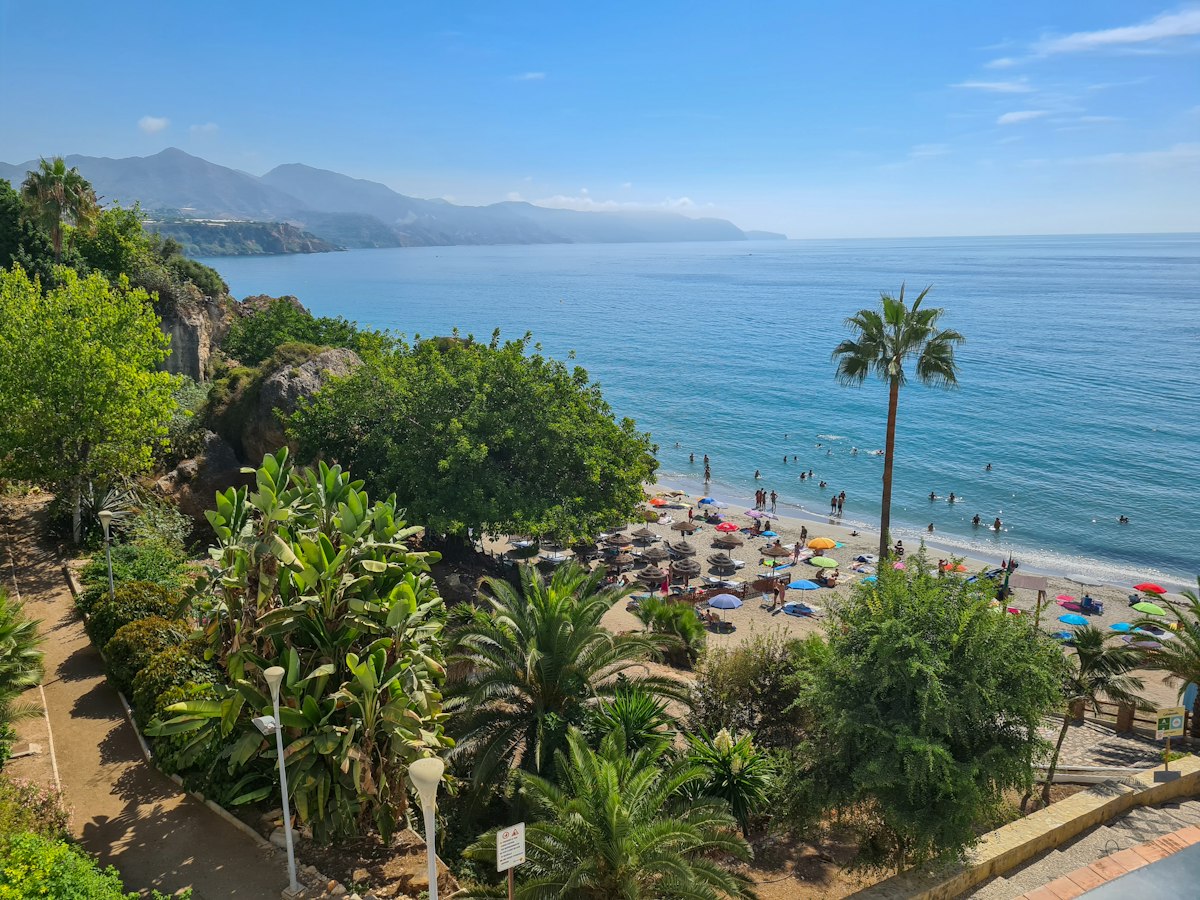
Platja Les Fonts — the main town beach, gently shelving sand, calm water, summer services including sun loungers and a chiringuito. A family beach in the traditional Spanish sense: local, unhurried, no jet ski rental huts.
Platja del Moro — a pocket of fine sand backed by low cliffs at the edge of the natural park zone. Quieter than Les Fonts, accessible by path. The kind of beach that makes you feel you've found something the guidebooks missed.
Cap i Corp — further into the natural park, accessed on foot. Rocky and wild, suitable for snorkelling. Almost no facilities, which keeps the numbers manageable.
Las Casas de Alcocebre — the older fishing port settlement, 3km south of the main beach. A small beach alongside the port, and the area where the traditional fishing community element of the town is most visible. Some of the older, cheaper apartment stock is here.
None of these beaches is going to be described as a party beach. That is entirely the point. In August, Spanish families fill the town. Out of season, the beaches are largely empty, the light is extraordinary, and the silence is the kind you have to travel to find.
Alcossebre Property Prices: What to Expect in 2026
Alcossebre's property market is small by the standards of Costa Blanca resorts, and stock turns over slowly. The dominant format is apartments — mostly low-rise blocks built from the 1970s through the 1990s, with a smaller number of townhouses and individual villas. New build is extremely limited, partly because the natural park constrains expansion and partly because the Spanish domestic market hasn't driven the developer interest that larger international resorts attract.
Indicative price ranges:
- Studio / 1-bedroom apartment (resale): €70,000–€130,000
- 2-bedroom apartment with community pool (resale): €90,000–€160,000
- 2-bedroom apartment, reformed, good position: €130,000–€185,000
- Townhouse (2–3 bed, own garden or patio): €120,000–€220,000
- Villa (3–4 bed, private pool): €180,000–€400,000
- New build (very limited): €200,000–€320,000 for a 2-bed where available
As with all Spanish property purchases, budget 10–12% on top of the purchase price for costs: ITP (transfer tax, typically 10% in the Valencia Community), notary fees, land registry, and gestoría. Our buying costs guide has the full breakdown.
The Market Character: Why Prices Are What They Are
Alcossebre is a Spanish market. Not in the sense that buying there requires navigating unusual legal complexity — the standard Valencia Community process applies — but in the sense that the buyers, the sellers, and the pricing logic are all shaped by Spanish domestic demand rather than international buyers inflating values.
The typical buyer here is a Valencian or Catalan family purchasing a summer base. This pattern has been stable for decades. It means prices track the Spanish domestic economy — employment in Valencia, consumer confidence in Catalonia — rather than British exchange rates, German investor appetite, or Dutch pension fund performance. When those external markets experience volatility, Alcossebre absorbs less of the impact.
The flip side is that international buyers have less of a market infrastructure to support them. English-speaking estate agents are thin on the ground compared to Torrevieja or Orihuela Costa. You will want a good bilingual gestoría or lawyer. The buying process is entirely manageable, but you are operating with fewer English-language hand-holds than you would find on the more internationally developed stretches of coast.
Dutch and French buyers appear occasionally in this market — both groups have a history of seeking out value on the Spanish Mediterranean rather than following the British coastal trail. British and German buyers remain genuinely rare. If you are looking at Alcossebre as an international buyer in 2026, you are getting in before any significant international discovery.
The Rental Market: Honest Assessment
Alcossebre's rental market is concentrated almost entirely in July and August. Spanish domestic demand — primarily from Valencia, Castellón, and the larger Catalan cities — fills the town during school summer holidays reliably. A 2-bedroom apartment in a decent position close to the beach can achieve €700–€1,000 per week during peak season. Some well-presented townhouses or villas achieve considerably more.
Outside peak summer, the picture is honest rather than optimistic. June and September can bring weekend visitors and some families on extended holidays, but occupancy falls sharply. October through May, the town quietens to a trickle of off-season visitors and year-round residents. This is not the year-round rental machine that the Costa Blanca's more international resorts approximate. Alcossebre is a genuine seasonal resort.
A practical calculation: a 2-bed apartment achieving 6–8 peak weeks at €800 average gross (€4,800–€6,400) plus light shoulder-season bookings might generate €6,000–€8,000 annually. Against a purchase price of €130,000, that's a gross yield of 4.5–6% before costs. Not spectacular, but not negligible either — and the asset is priced rationally, not inflated by international demand expectations.
The Valencia Community VT rental licence process applies here. The Vivienda Turística (VT) licence must be obtained through Turisme Comunitat Valenciana. Requirements include a valid cédula de habitabilidad (first-occupancy licence), compliance with specific standards for holiday rental properties, and registration in the regional tourism registry. Some areas of the Valencia Community have imposed moratoriums on new licences due to housing pressure. Before committing to any property you plan to rent out, verify the licence status and whether a new application is viable. A property that already holds a valid VT licence is considerably lower risk. Our holiday rental licence guide covers the process in detail.
Alcossebre vs the Costa Blanca: The Core Trade-off
Most international buyers comparing Spanish coastal property will have the Costa Blanca as a reference point. The comparison is worth making directly.
The Costa Blanca — particularly the north coast around Dénia, Jávea, Moraira, and Calpe — offers higher international profile, more established resale markets with liquid buyer pools, closer access to Alicante Airport (for the south) and Valencia Airport (for the north), and a more developed English-speaking infrastructure. These are real advantages if your priorities include ease of use as a non-Spanish speaker and a stronger resale position when you come to exit.
What Alcossebre offers in return: lower prices, genuine unspoiled coastline protected by natural park status, a more authentic Spanish experience, and a value proposition that has not yet been distorted by decades of international demand. If the Costa del Azahar follows the trajectory of the Valencia Community more broadly — growing in international recognition as Valencia the city continues its rise — early buyers in Alcossebre are well-positioned. That is a growth narrative, not a guarantee, but it is grounded in observable regional trends.
Castellón de la Plana: Your Services Hub
The nearest city of any size is Castellón de la Plana, approximately 30km south of Alcossebre. It is a proper Spanish provincial capital: university, general hospital, main railway station on the Madrid–Valencia–Barcelona AVE corridor (via high-speed rail to Valencia Joaquín Sorolla), commercial shopping, and the full range of municipal services.
For buyers based in Alcossebre, Castellón serves the role that Alicante or Murcia plays for Costa Blanca buyers — a larger urban centre for medical appointments, serious shopping, and administrative tasks. The drive on the N-340 or AP-7 takes around 30 minutes.
The town of Alcalà de Xivert — the inland municipality of which Alcossebre is the coastal settlement — is 10km inland. Smaller and quieter, it has its basic services and a well-preserved historic centre. If you are buying in the area long-term and want to understand the community beyond the beach strip, Alcalà de Xivert is worth visiting.
Who Is Buying in Alcossebre?
The honest picture: Spanish families, overwhelmingly. Valencian and Catalan families with a summer tradition here that stretches back generations. The resale market is largely Spanish sellers and Spanish buyers — families releasing equity, upgrading, or consolidating inheritances.
International buyers are a small minority, and most of them are Dutch or French rather than British or German. The market has not developed the English-speaking estate agent ecosystem, the British bar infrastructure, or the international buyer forums that characterise the more internationally colonised stretches of Spanish coast.
For the right international buyer — someone who wants unspoiled coast, is comfortable navigating a Spanish-language market with professional support, and is not looking for an expat bubble — this is not a problem. It is, in fact, the attraction. You are buying into something that works on its own terms, has its own character, and does not exist primarily to service non-Spanish buyers.
Frequently Asked Questions
Is Alcossebre on the Costa Blanca?
No. Alcossebre is on the Costa del Azahar, which covers the Castellón province coastline. The Costa Blanca begins roughly at Dénia in Valencia province, approximately 80km to the south. The distinction is more than geographical — the Costa del Azahar has a different market profile, much lower international buyer presence, and a coastline that has been far less developed. The Sierra de Irta natural park, which runs to the sea immediately north of Alcossebre, is only possible because this stretch of coast was never subjected to the development pressure of the Costa Blanca.
Is Alcossebre suitable for non-Spanish buyers?
Practically, yes — the buying process follows standard Valencia Community procedure, and a good English-speaking lawyer or gestoría will handle the documentation without difficulty. Culturally, you are operating in a Spanish environment without much English-language infrastructure. Estate agents, neighbours, and local services will primarily be Spanish-speaking. If that's fine with you, there's no barrier. If you want the full English-speaking support network, the Costa Blanca is better set up for that.
What are property prices in Alcossebre?
In 2026, resale 1-bedroom apartments start from around €70,000–€90,000. A 2-bedroom apartment with community pool runs €90,000–€160,000 for standard resale stock, rising to €130,000–€185,000 for recently reformed units in better positions. Townhouses range from €120,000–€220,000. Private villas with pools run €180,000–€400,000 depending on size, condition, and views. Prices are materially lower than equivalent Costa Blanca properties and represent good value relative to the coastal quality on offer.
Is the Costa del Azahar worth buying on?
It depends what you want. If you want unspoiled Mediterranean coast, very little international buyer noise in the market, genuine value, and the long-term optionality of a region growing in profile as Valencia's international reputation expands, then yes — the Costa del Azahar is worth serious consideration. Alcossebre specifically benefits from permanent natural park protection that gives it a structural advantage over coastal resorts that can theoretically be overdeveloped in the future. The rental market is seasonal and concentrated in summer; if year-round yield is your primary objective, look elsewhere. If capital value, lifestyle use, and a market that's not already priced for international demand are your priorities, this coast has real arguments in its favour.
---
For the full legal and financial picture of buying in Spain, our complete buying guide covers every step from offer to notary. If you're comparing Valencia Community options, the Valencia property guide covers the city, the Gandía property guide covers the coast 70km to the south, and the Costa Blanca property guide covers the full stretch from Dénia to Torrevieja. For rental licensing in the Valencia Community, see our holiday rental licence guide.
Ready to find your property in Spain?
Browse thousands of verified listings from licensed local agents.
Browse properties →