Most people who buy in Orihuela municipality never visit the city. They land at Alicante, drive south on the AP-7, and end up in Cabo Roig or La Zenia — which are fine — without ever knowing that 30 kilometres inland, one of Spain's most extraordinary historic cities is sitting largely undiscovered, with apartments starting at €40,000 and a skyline of Gothic towers and Renaissance domes.
That's the Orihuela story worth telling. Not Orihuela Costa (we have a separate guide to that), but the city itself: the former capital of the Kingdom of Murcia, a place with more ecclesiastical architecture per square kilometre than almost anywhere in Europe, a living Spanish university town, and a property market that has barely registered on the international buyer radar.
If you're looking for authentic Spain at a fraction of coastal prices, Orihuela city deserves a serious look.
Orihuela: A City That Was Once a Capital
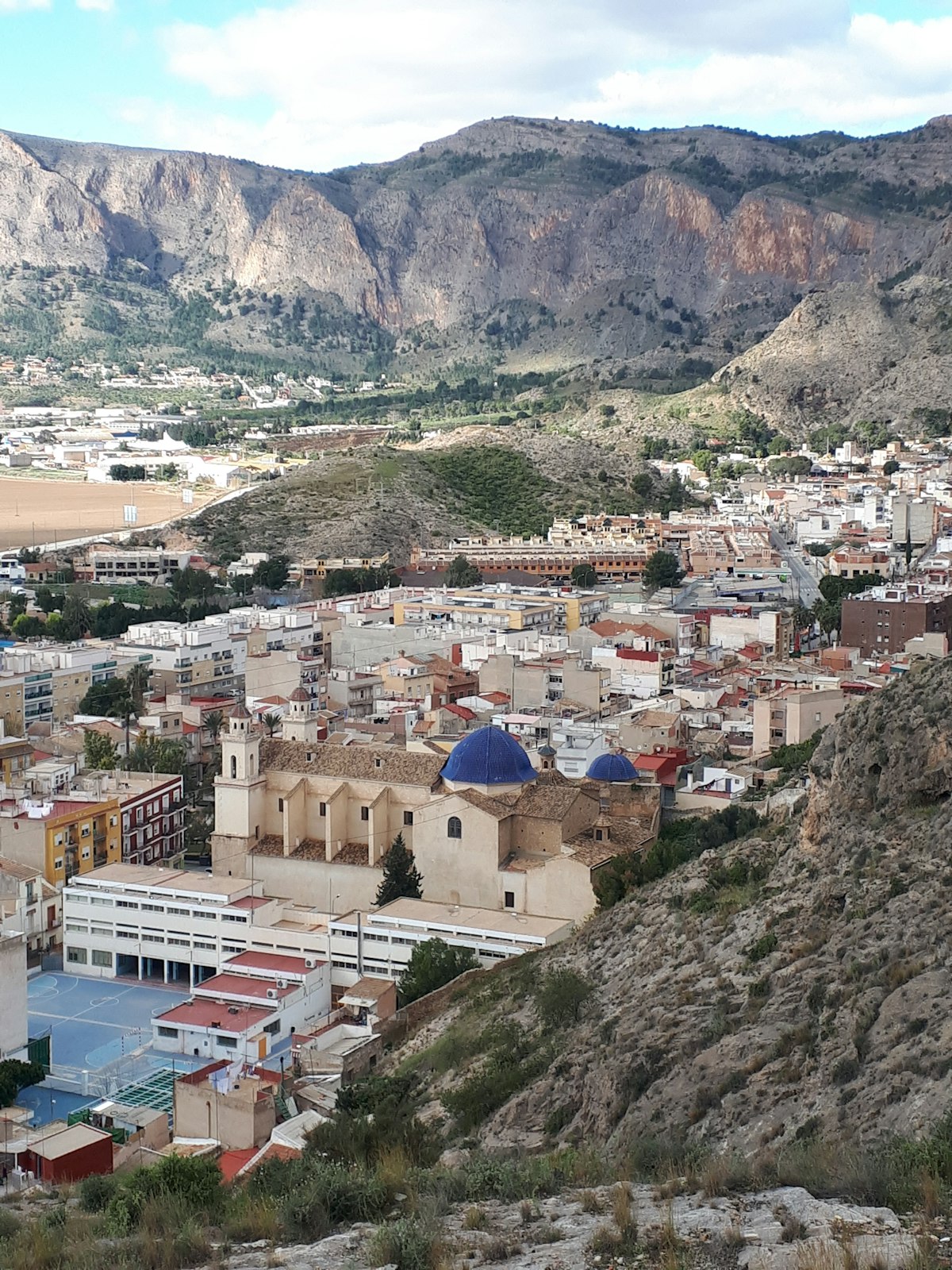
Orihuela sits on the banks of the River Segura in the Vega Baja del Segura, the fertile southern strip of Alicante province, about 50 kilometres south of Alicante city and 30 kilometres north of the coast. It has a population of around 80,000 — a genuine medium-sized Spanish city, not a village — with a history that goes back to the Moors and beyond.
For much of the medieval period, Orihuela was the capital of the Kingdom of Murcia, a position that funded the extraordinary programme of construction you can still see today. The Catedral de Santiago y San Juan is a 15th-century Gothic cathedral with an interior of shocking scale for a city this size. Around it, in a tight historic quarter of twisting streets and limestone facades, sit Baroque churches, Renaissance palaces and convents that wouldn't look out of place in Salamanca or Toledo. The city was also home to the poet Miguel Hernández — one of the most important voices of the Generation of '27 — and has honoured him with a university that still bears his name.
This heritage does two things for property buyers. First, it creates a quality of life — festivals, civic pride, a physical environment of genuine beauty — that can't be replicated in any of the purpose-built coastal urbanisations. Second, it creates a genuine planning constraint on historic centre properties, which is both a complication and a protection.
Why Orihuela City Instead of the Coast?
The honest pitch is simple: you get more Spain, more history and more square footage for far less money.
Orihuela Costa attracts international buyers precisely because it looks familiar — English-speaking agents, expat-friendly amenities, beaches within walking distance. But that familiarity carries a price premium, and it removes much of what makes living in Spain distinctive. For a growing segment of buyers — people who have already done the holiday-home thing and want something more rooted, or who want to make a full relocation rather than just a second home — the inland city offers a completely different proposition.
You would pay €150,000 for a modest apartment in Orihuela Costa. In the historic centre of Orihuela city, that budget could get you a spacious apartment in a baroque building on a cobbled street — possibly needing renovation, but with architectural character that no modern development can match. For buyers who want a project, a cultural life and a genuine Spanish neighbourhood, the city wins on almost every measure except beach access.
The beach question is real: Orihuela Costa's beaches are 35–40 kilometres away. But they are accessible — a comfortable 40-minute drive — which means the city can function as a base with the coast as a day trip, rather than a permanent retreat from the sun.
Neighbourhoods Worth Knowing
Centro Histórico is the architectural heart of the city — the streets between the cathedral, the river and the old city walls. Property here is a mix of large apartments in converted historic buildings, old townhouses (casas de pueblo) and smaller flats in 20th-century infill blocks. Much of the stock is cheap relative to almost anywhere in coastal Spain, partly because of condition (many buildings haven't been properly maintained) and partly because there has been essentially no international buyer pressure to push prices up. This is both the most interesting and the most demanding neighbourhood for buyers: the architecture is exceptional, the renovation requirement is often significant, and the planning rules for historic buildings add complexity.
Parroquias — the residential neighbourhoods surrounding the centre — offer a more conventional purchase: apartment blocks from the 1970s to the 2000s, some with parking and community pools, in a working Spanish residential environment. Prices here are higher than the centre but lower than the coast, and the condition of individual units varies enormously. This is where most local families and long-term residents live.
Barrio de San Isidro and the outskirts cover the newer residential developments on the edge of the city — detached houses, semi-detached properties and modern apartment blocks built from the 1990s onwards. These are typically the best-condition, most family-oriented properties in the municipality (excluding the coast), with good schools, supermarkets and local services nearby. Prices are higher per square metre than the historic centre, but still dramatically below coastal equivalents.
The University campus is near the historic centre and brings a student population that creates demand for rental property — a genuine income-generation angle that the coastal urbanisations, with their holiday-let focus, don't offer in the same way.
Property Prices in Orihuela City
The numbers here are a different category from the coast, which is either a feature or a bug depending on what you're looking for.
City centre apartments (often older, may need work): from €40,000–€90,000 for a one- to two-bedroom flat in the historic centre or surrounding streets.
Larger apartments and houses in the residential areas: €80,000–€160,000 for two- to three-bedroom property in reasonable condition across the Parroquias and newer barrios.
Renovated historic centre property: €100,000–€250,000 for a well-presented apartment or townhouse in a prime historic location after renovation works. These are genuinely exceptional properties at these prices — comparable architectural quality in Granada, Seville or Valencia would cost three to five times more.
New or near-new residential property on the outskirts: €130,000–€200,000 for a modern three-bedroom house with garden, depending on location and specification.
The renovation opportunity is real and significant. There is a cohort of buyers — typically those with building experience, time, or an appetite for a project — for whom the historic centre represents extraordinary value. A building purchased for €60,000–€80,000 and renovated to a high standard can become a genuinely remarkable home at a total cost that remains below what similar space would cost anywhere on the coast. The complications are equally real: historic buildings require licensed architects and specialist contractors, works within protected zones require permission from the heritage authority (the Dirección General de Cultura), and timelines are routinely extended by the approval process. Budget and schedule conservatively.
Culture, Festivals and What Daily Life Looks Like
Orihuela is not a tourist city. This is a working Spanish city where life carries on in Spanish, at Spanish pace, with Spanish customs. That will appeal to some buyers and be too much of an adjustment for others.
Semana Santa in Orihuela is one of the most important Holy Week celebrations in Spain — elaborate processions, centuries-old brotherhoods (cofradías) and a level of civic participation that makes the event a genuine experience rather than a performance. The city's historic churches are the staging ground for processions that draw visitors from across Spain.
Moros y Cristianos — the annual festival re-enacting the medieval battles between Moorish and Christian armies — runs in the summer months and is another major event in the civic calendar. These festivals matter because they signal the depth of civic culture in the city: this is a place where community identity is actively maintained, not just preserved for tourists.
The number of churches per head of population in Orihuela is genuinely extraordinary — over 20 historic religious buildings in a city of 80,000 — and even non-religious buyers benefit from the extraordinary public architecture this has created. The city is essentially an outdoor architectural museum that nobody has discovered yet.
Miguel Hernández University has a campus in Orihuela (the university's main campus is in Elche), which sustains a student population and the café culture, bookshops and social life that comes with it. For buy-to-let investors, student lets are a consistent demand stream that operates year-round rather than seasonally.
Transport and Getting Around
Alicante–Elche Airport is 55 kilometres north — about 45–50 minutes by car on the AP-7 motorway. This gives Orihuela city reasonable connections to the UK and Northern Europe, though you're at the outer edge of the comfortable catchment for a purely holiday-use property.
Murcia International Airport (Corvera, RMU) is approximately 30 kilometres south and is increasingly useful as a second option, with Ryanair and easyJet routes to UK and European cities.
RENFE trains connect Orihuela with both Alicante and Murcia — the route runs several times daily and takes around 40 minutes to either city. For buyers who want to live and work in Spain, the rail link makes Murcia city in particular genuinely accessible for commuting or regular visits. Neither Alicante nor Murcia is a large international city, but both have hospitals, universities, theatres and full urban services that Orihuela's size can't support alone.
Within the city, a car is useful but not as essential as in the coastal urbanisations, where no car means no independence. The historic centre is walkable, and most of the Parroquias are within cycling distance of the centre.
Who Actually Buys in Orihuela City?
Based on the current buyer profile, the city attracts a particular type of purchaser who is explicitly not looking for what Orihuela Costa offers:
Culture seekers and slow-travel buyers who have already spent time in the coastal zones and found them too transactional. They want to live *in* Spain rather than in a Spanish-climate version of somewhere else.
Buyers priced out of the coast who have done the maths: a budget of €100,000–€150,000 goes much further here, and the lifestyle trade-off is a beach that requires a car trip rather than a beach that's walkable.
Remote workers for whom the combination of fast broadband (available in the city and expanding), low cost of living, authentic Spanish culture and reasonable airport access makes Orihuela city a genuinely viable base. Spain's Digital Nomad Visa has made this increasingly formalised — see our guide to the Digital Nomad Visa.
Project property buyers who want to buy a historically significant building at low entry cost, renovate it, and end up with something that couldn't be built from scratch at any price.
Buy-to-let investors targeting the student rental market, long-term local lets, or the emerging market of cultural-tourism visitors to the historic centre.
Frequently Asked Questions
Is Orihuela city worth buying in?
Yes — with the right expectations. It is not a proxy for Orihuela Costa and should not be treated as one. It is a different purchase, aimed at a different buyer. If you want beach access, built-in expat community and a proven holiday-rental market, buy on the coast. If you want an extraordinarily beautiful historic city, genuinely low prices and a very Spanish way of life, Orihuela city is one of the most undervalued locations in southern Spain.
Is Orihuela the same as Orihuela Costa?
No — and this confusion is responsible for more buyer disappointment than almost any other single issue in this part of Spain. Orihuela is the historic inland city, population ~80,000, 30km from the sea. Orihuela Costa is the coastal resort strip — Cabo Roig, La Zenia, Las Piscinas, Campoamor — 35–40km southeast. Both are within the same administrative municipality, but they are entirely different places with different property markets, different populations and different reasons to buy.
What are property prices in Orihuela city?
Significantly cheaper than the coast. City centre apartments start from around €40,000 for older or project stock; good-condition apartments in the residential neighbourhoods run €80,000–€160,000; renovated historic centre properties with character reach €100,000–€250,000. For the historic city of this quality, these are exceptional numbers.
How far is Orihuela from the beach?
About 35–40 kilometres to Orihuela Costa beaches — roughly a 40-minute drive. Other beaches (Guardamar del Segura, Torrevieja) are of a similar distance. The city is not a coastal purchase; the coast is a day-trip destination. If walkable beach access is a priority, the city is not the right location.
The Bottom Line
Orihuela city is the answer to a question most buyers don't think to ask: what if you could buy in a genuinely extraordinary historic Spanish city, at prices that have barely moved in a decade, before international buyers worked out it exists?
The city has real complications — renovation works are often necessary, historic building permissions are slow, and the international buyer infrastructure (English-speaking agents, established expat services) is thin compared to the coast. These are manageable challenges for the right buyer, and they are precisely why prices remain where they are.
For buyers who want to go deeper into Spain than Orihuela Costa allows, this is one of the most compelling purchases available. The cathedral alone is worth the trip to see it.
---
*Property prices current as of Q3 2026. Always verify current tax rates, planning requirements and heritage permissions with a qualified Spanish abogado. This guide is for informational purposes only.*
---
Search available properties in Alicante province — or read our guide to buying costs in Spain to understand the full cost of purchase.
Ready to find your property in Spain?
Browse thousands of verified listings from licensed local agents.
Browse properties →