# Nerja vs Frigiliana: Which Should You Buy In?
They are seven kilometres apart. On a clear day, you can stand in Frigiliana's hilltop square and see Nerja's coastline shimmering below. Yet these two villages — arguably the most beguiling spots on the entire eastern Costa del Sol — attract buyers who want almost entirely different things.
This guide cuts through the romanticism. Both places are genuinely stunning. Neither is a bad choice. But they suit different lifestyles, different investment strategies, and different personalities. By the end, you should know which one is yours.
---
The Lay of the Land
Both Nerja and Frigiliana sit in the Axarquía, the mountainous comarca east of Málaga that remains one of the least developed stretches of Andalucía's coast. The landscape is dramatic: the Sierras Tejeda, Almijara and Alhama tumble almost directly into the Mediterranean, leaving precious little flat ground.
Nerja (population ~22,000) occupies that narrow coastal strip. It is a proper town: beaches, restaurants, supermarkets, international schools, healthcare, and a year-round expat community largely made up of British, Dutch, and Scandinavian residents. It has been a popular destination since the 1960s and has grown steadily without — impressively — losing too much of its character.
Frigiliana (population ~3,000) sits at roughly 300 metres above sea level on the southern flank of the Sierra de Almijara, connected to Nerja by a road that winds through citrus and avocado groves. It is a white village in the fullest sense: narrow cobbled lanes, flower-draped walls, Moorish archways, and an almost complete absence of modern development. It has repeatedly been named one of the most beautiful villages in Spain, and the title is not undeserved.
The distance between them is small. The difference in daily life is large.
---
Nerja: Beach Town with Substance
What makes it special
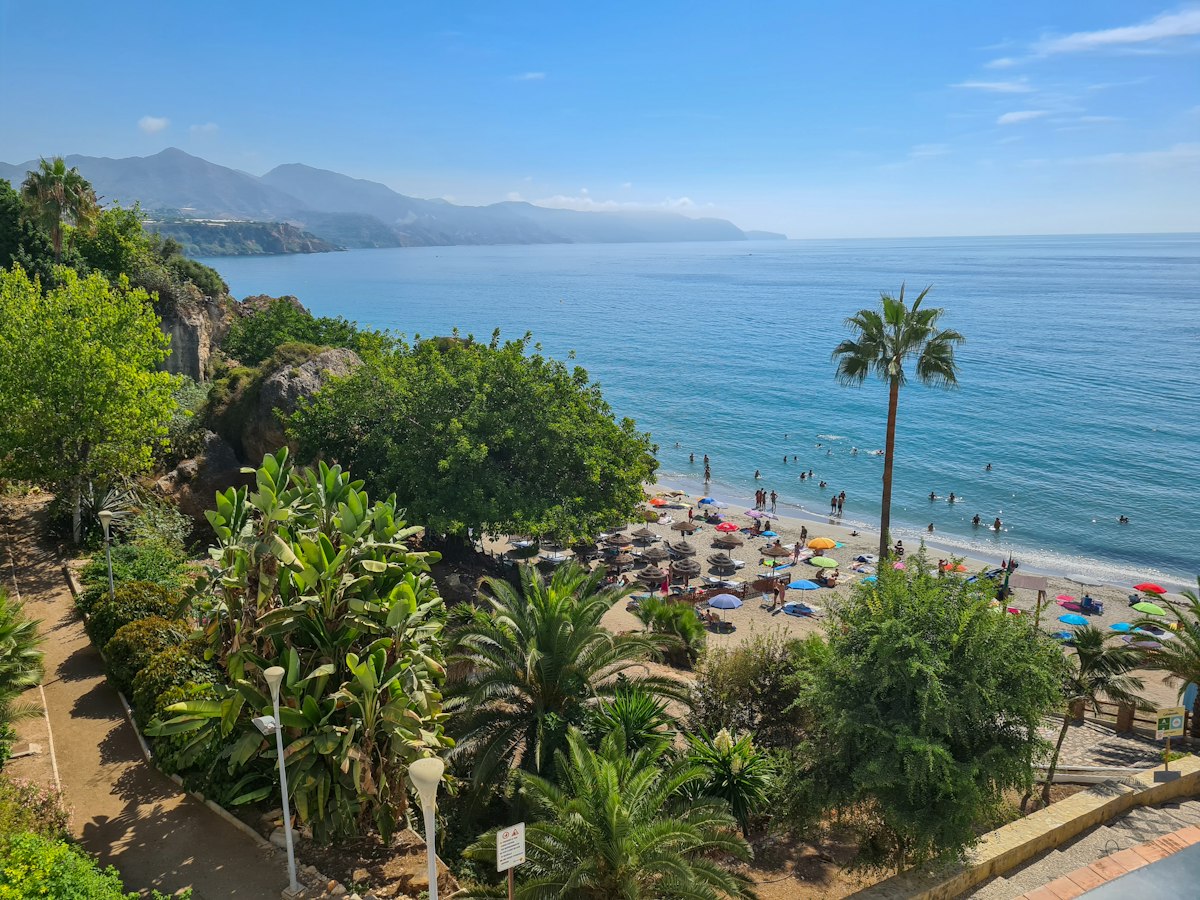
The Balcón de Europa — a clifftop promenade jutting out over the sea at the heart of the old town — is one of the more theatrical viewpoints on the Spanish coast. King Alfonso XII reportedly named it after standing there in 1885; the name stuck, and the view has not got any worse.
Beneath the Balcón lie Nerja's beaches, including Playa Burriana (the longest, most facilities, great for families) and Playa Calahonda (smaller, rockier, more atmospheric). Across the town's 16km of coastline there are roughly a dozen beach and cove options, most reachable without a car.
Then there is the Cueva de Nerja — a vast prehistoric cave system three kilometres east of town that draws around half a million visitors per year. The caves are among Spain's most visited tourist attractions and host a famous summer concert series. This single attraction does significant heavy lifting for the local economy.
Nerja has real infrastructure: a weekly market, a good selection of international and Spanish restaurants, several supermarkets including a Mercadona, private healthcare clinics, and a range of international schools within reasonable commuting distance in Málaga. It is genuinely liveable as a full-time base.
Who lives here
The expat community is well-established — there are active social clubs, English-language services, and enough familiar faces that arriving alone does not feel isolating. Spanish residents still outnumber foreigners, which keeps the town from feeling like a British enclave. Peak summer brings significant tourist volumes, but outside July and August the town returns to a more relaxed rhythm.
---
Frigiliana: The Village That Earns Every Superlative
What makes it special
Frigiliana is genuinely one of the most beautiful settlements in Andalucía. The upper barrio — the Moorish quarter known as the Barribarto — has been preserved almost intact, with whitewashed houses climbing the hillside in tightly packed terraces. Colourful ceramic tiles along the main lane tell the story of the 1569 Moorish revolt. The views across the valley to the sea are extraordinary.
Life here moves slowly. There is one main street, a handful of restaurants (some exceptional), a small weekly market, and a community of artists, writers, and long-term expats who came for a short stay and never left. The hiking is world-class: the Sierra Almijara offers routes ranging from gentle valley walks to serious mountain treks, with ancient mule paths connecting villages that have not changed in centuries.
There is no beach. The nearest is in Nerja, 7km and fifteen minutes of hairpin bends away.
Who lives here
Frigiliana attracts a particular type. Artists, architects, and writers feature heavily. People who actively want to slow down, who value craft over convenience, and who are comfortable — even delighted — by the absence of a cinema, a Zara, or a reliable taxi. The community is small enough that new arrivals are noticed and, generally, warmly absorbed.
---
Property: What Your Money Buys
Nerja prices
Nerja offers genuine variety. At the lower end, town apartments in the centre or upper barrios start from around €150,000–€280,000 for a two-bedroom property. Add a sea view and the premium is significant: sea-view apartments typically range from €200,000 to €400,000+, with penthouses and front-line properties well above that.
Villas and detached houses in and around Nerja command €350,000–€800,000+, with outliers above €1m on the more desirable hilltop plots. The broad price spread means buyers at most budgets can find something viable.
The market is competitive. Properties in the old town with original character sell quickly, and anything with a genuine sea view rarely sits on the market long.
Frigiliana prices
Frigiliana operates in a narrower band. Village houses — typically stone or rendered, often requiring some work — are available from around €150,000–€400,000. Renovated properties with modern interiors but traditional exteriors (the most sought-after combination) sit in the €200,000–€500,000 range.
Because there is no seafront, there is no sea-view premium in the Nerja sense. Instead, properties are valued for orientation, valley views, outdoor terraces, and the quality of restoration. A well-renovated cortijo on the village edge with panoramic views and a pool is genuinely attainable at a price that would buy a modest sea-view apartment in Nerja.
What you do not get in Frigiliana: large new-build developments, gated communities, or properties suitable for buyers who want a plug-and-play holiday home without involvement in a village community.
---
Rental Income: The Honest Picture
Nerja
Nerja is a solid performer for holiday rentals. The beach season runs April to October, the Cueva de Nerja draws visitors outside those months, and the established expat community generates some long-term rental demand.
A well-located two-bedroom apartment can realistically achieve €15,000–€25,000+ in annual short-term rental income, with peak weeks in July and August commanding premium nightly rates. Winter is quieter but not dead — Nerja's mild climate attracts off-season visitors looking to escape northern European weather, and the town has enough going on to hold people for longer stays.
Rental licensing in Andalucía applies here as elsewhere in Spain: you will need a tourist licence (VFT) before listing on Airbnb or similar platforms.
Frigiliana
Frigiliana attracts a discerning niche: hikers, cultural tourists, artists, and honeymooners looking for something genuinely different. Demand is real but seasonal, concentrated between April and October, with the shoulder months of spring and autumn often stronger than midsummer (when the hilltop heat is considerable).
Annual rental income from a renovated village house is typically in the range of €8,000–€15,000, with less predictable year-round occupancy than a comparable Nerja property. Winter rental demand is weak. If maximising rental yield is your primary goal, Nerja is the better choice. If you want a beautiful property that pays some of its running costs while you are away, Frigiliana can deliver — just with more modest expectations.
---
Access and Practicalities
Nerja is well-connected. Regular bus services run to and from Málaga (roughly 90 minutes), the N-340 coastal road passes through town, and Málaga Airport is about an hour away. For full-time residents or frequent visitors, the logistics are straightforward.
Frigiliana adds a complication. The village is reached via the MA-5105, a road that climbs from the Nerja bypass through seven kilometres of mountain bends. It is entirely manageable — locals do it daily — but it requires a car, adds time to every journey, and can feel isolating if you do not drive or are not comfortable on narrow mountain roads. There is no direct bus service from Málaga; you connect via Nerja. For buyers considering full-time living, this warrants serious thought, particularly as one gets older.
Parking within Frigiliana's upper village is limited and largely impossible for cars within the Barribarto itself. You park on the edge and walk. This is part of the charm; it is also, occasionally, part of the frustration.
---
Head-to-Head: Which Buyer Are You?
Choose Nerja if you:
- Want regular, easy beach access as part of daily life
- Value a larger, established expat community and international services
- Are prioritising rental income and want strong year-round demand
- Prefer a more varied social scene — restaurants, bars, events — within walking distance
- Plan to live there full-time and need practical infrastructure (healthcare, transport, schools)
- Want more choice at more price points
Choose Frigiliana if you:
- Prioritise authenticity, beauty, and a genuinely unhurried pace of life
- Are drawn to an artistic, creative community rather than a classic expat scene
- Want hiking and mountain landscape as much as — or more than — the beach
- Are comfortable with fewer amenities and a car as an absolute requirement
- Can accept more modest rental returns in exchange for a more distinctive property
- Are not fully reliant on rental income to fund your purchase
Can you have both?
Many buyers based in Nerja make Frigiliana a regular part of their life — a Sunday lunch, a weekly walk, a half-hour drive up for the morning market. The proximity works both ways. A Nerja base gives you beach access, convenience, and rental strength while Frigiliana remains a ten-minute drive rather than a commitment.
Some buyers do it in reverse: they live in Frigiliana and accept the extra leg to get to the beach and the supermarket, treating Nerja as a service hub. This works well for full-time residents who are settled in village life.
What does not work well is buying in Frigiliana while expecting the conveniences of Nerja. The village is not that, and it is all the better for it.
---
Frequently Asked Questions
Is Nerja or Frigiliana more expensive?
For like-for-like living space, the price difference is smaller than many expect. Nerja commands sea-view premiums that push top-end prices significantly higher, but entry-level properties are broadly comparable. A renovated village house in Frigiliana with mountain views can cost as much as a sea-view apartment in Nerja. Neither is cheap; both offer reasonable value by Spanish coastal standards.
Is Frigiliana good for rental income?
It can generate meaningful rental income during the spring-to-autumn season, particularly for well-presented boutique properties. However, it is not a strong year-round rental market. Buyers relying heavily on rental income to cover mortgage costs or running expenses should model conservatively and compare against Nerja alternatives.
How far is Frigiliana from the beach?
Seven kilometres by road — roughly 15 minutes of driving, depending on traffic and whether you stop to let a delivery lorry pass on the narrow bends. It is not far, but it is a journey you make every time, and you need a car to do it. For some buyers this is entirely fine; others find it more restricting than they anticipated.
Is Nerja better than Frigiliana for full-time living?
For most full-time residents, yes — particularly those who value social life, practical amenities, healthcare access, and easy transport links. Nerja is a functioning town with real services. Frigiliana is a beautiful village with limited infrastructure. Both attract full-time residents, but the profile of those residents differs markedly: Frigiliana suits people who have actively chosen simplicity, while Nerja suits a broader range of full-time lifestyles.
---
The Bottom Line
Both Nerja and Frigiliana are exceptional. The Axarquía region as a whole is one of the most underrated stretches of the Spanish coast, and either of these villages would be a fine place to own property.
But they are not interchangeable. Nerja is for buyers who want the beach central to their life, an established community around them, and a property that works hard as a rental. Frigiliana is for buyers who are willing to trade convenience for something rarer: the feeling of living inside one of Spain's most beautiful villages, largely undisturbed by mass tourism, with the kind of quiet that is increasingly hard to find.
If you are genuinely torn, spend a week in each before deciding. Stay in the village itself, not a hotel on the edge. Walk the streets at 7am when the tourists have not yet arrived. That is where the answer will come from.
Voya Spain covers both markets. Browse properties in Nerja and the Axarquía or get in touch if you would like guidance on where to focus your search.
Ready to find your property in Spain?
Browse thousands of verified listings from licensed local agents.
Browse properties →