Almería City: The Provincial Capital Almost No One Is Talking About
If you drew a map of where international buyers are active in Andalusia, you would shade in Málaga, Granada, Sevilla, and the coastlines between them. Almería city would be a pale blank. For buyers who know what to look for, that blank space is one of the most interesting opportunities in southern Spain right now.
Almería is the capital of Almería province, with a population of around 200,000. It sits on the Mediterranean coast, commands one of the finest Moorish fortresses in Spain, and enjoys approximately 3,000 hours of sunshine per year — more than almost anywhere else in Europe. It has a working port, a university, a direct train to Madrid and Barcelona, city beaches, and a food culture built around the tradition of serving free tapas with every single drink.
It also has, by some distance, the cheapest property prices of any Spanish provincial capital. The reasons for that are worth understanding — because some of them are changing.
---
The Alcazaba: World-Class Heritage, Local Prices
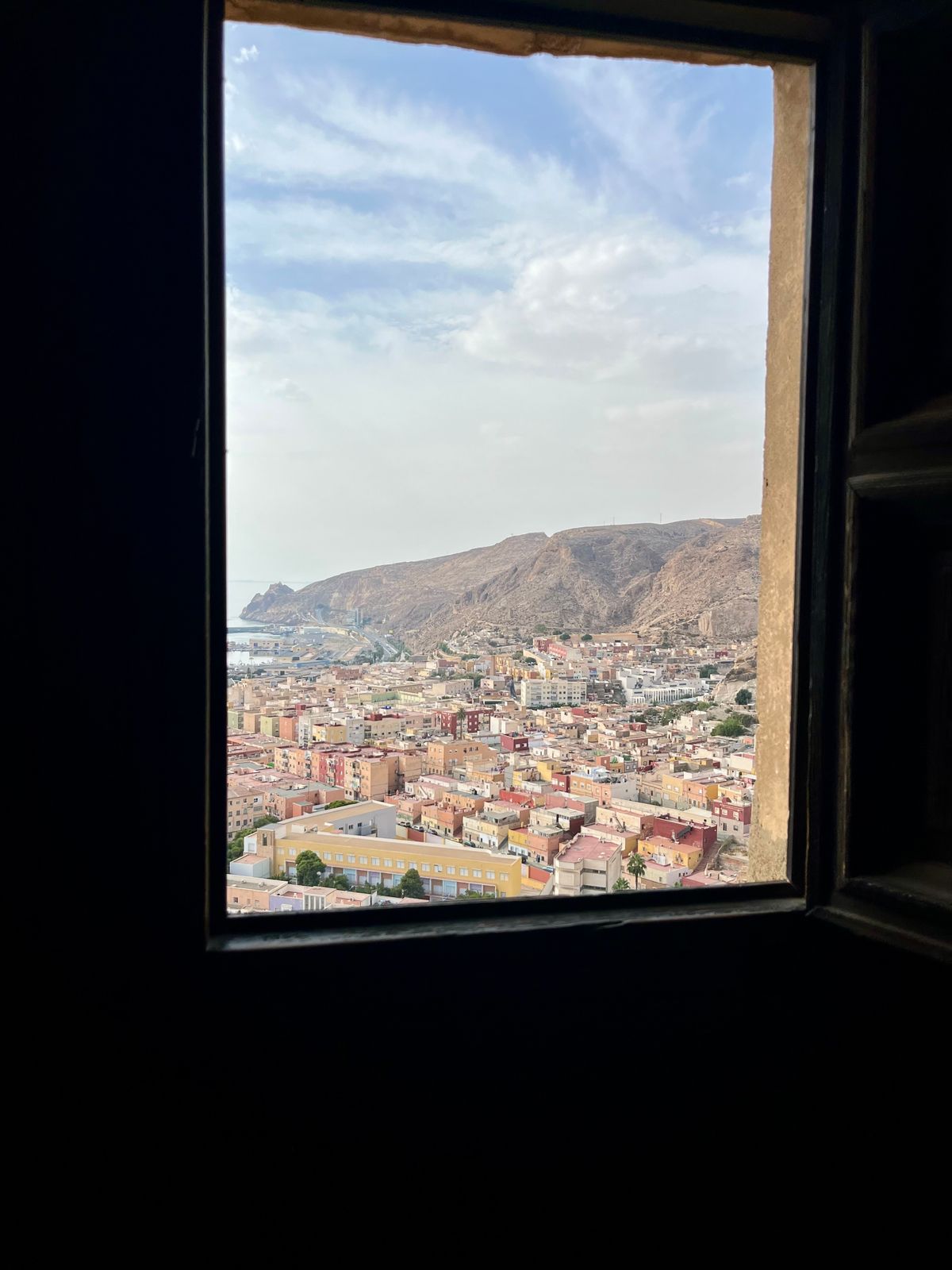
Before we talk numbers, it is worth being honest about what Almería actually has. The Alcazaba of Almería is a Moorish hilltop fortress built in the 10th century under Abd al-Rahman III. It is, alongside the Alhambra in Granada, one of the great surviving examples of Moorish military architecture in Spain. Three kilometres of walls. Gardens. A keep. Views over the city and the sea that would make any estate agent blush.
The Alhambra draws four million tourists a year. The Almería Alcazaba draws a fraction of that — and sits in a city where apartments cost a third of what they cost in Granada. Make of that what you will.
The old town around the fortress and the 16th-century cathedral is genuinely beautiful: narrow whitewashed streets, shaded plazas, traditional cafes where a caña costs €1.50 and arrives with a plate of food. This is not a theme-park version of Andalusia. It is the real thing, slightly overlooked.
---
Why Are Prices So Low?
This is the question every sensible buyer should ask. The short answer is reputation: Almería province has spent decades associated in the popular imagination with its vast greenhouse industry — the so-called Mar de Plástico (sea of plastic) that covers much of the surrounding countryside and produces 30–40% of Europe's fresh vegetables. That image — utilitarian, agricultural, not obviously glamorous — has kept international interest low relative to neighbouring provinces.
The longer answer is that Almería city itself has never had a moment. Granada has the Alhambra and the student scene. Sevilla has the flamenco and the architecture. Málaga has reinvented itself as a cultural destination. Almería has been quietly getting on with things, which is partly why it remains so affordable.
What that narrative misses:
- The agricultural economy is extremely stable. Fifty thousand-plus workers and a deep supply-chain ecosystem around the province's food industry means Almería city's economy is not dependent on tourism in the way that coastal resort towns are.
- The city itself is thoroughly liveable — full medical facilities, strong schools, a functioning port, good retail, and a nightlife scene anchored by its extraordinary tapas culture.
- Cabo de Gata, one of Spain's most spectacular and least-developed coastlines (a protected natural park of volcanic cliffs, turquoise bays, and near-deserted beaches), is 30 minutes from the city.
---
Key Neighbourhoods
Centro Histórico
The old town, clustered around the Alcazaba and the Cathedral of the Incarnation, is the obvious starting point for buyers drawn to Almería's heritage character. Architecture here ranges from genuinely beautiful to in need of a serious project, and prices reflect the variation accordingly.Older apartments in the historic centre — some with the high ceilings and thick walls of traditional Andalusian construction — can be had from as little as €40,000–€60,000 for a one-bedroom, though you should budget for some refurbishment work. Buyers willing to renovate can unlock good value; the bones of the buildings are often excellent.
El Zapillo
El Zapillo is Almería's seafront urban district — a strip of city beach running northeast of the port, lined with modern apartment blocks, bars, and restaurants. This is where younger professionals and families who want beach-adjacent city living tend to gravitate.Apartments here are more modern, generally in better condition, and command a small premium for the sea views and the location. A two-bedroom in a decent building typically runs €90,000–€150,000. It is the closest Almería has to a recognisable coastal resort feel — but at a fraction of the prices you would pay on the Costa del Sol or Costa Blanca.
Nueva Almería
A modern residential district to the west of the centre, Nueva Almería was built primarily in the 1990s and 2000s and has the infrastructure to match: wide roads, car parks, good schools, supermarkets, and well-maintained community areas. Families who want space, newer stock, and good amenities without being in the thick of the historic centre tend to end up here.Prices in Nueva Almería are reasonable rather than exceptional — two-bedroom apartments typically €80,000–€130,000 — but the quality of stock is generally higher and the community-fee situations better managed.
El Alquián
A quieter satellite village south-east of the city, close to Almería Airport. El Alquián is the cheapest area of the city's commuter belt — studios and one-bedroom flats from €40,000, two-bedrooms from €65,000. The airport location is either a convenience or a mild irritant depending on your tolerance for flight paths. For buyers who want the most property for the least money in a functional residential area, El Alquián is worth considering.---
Property Prices
Almería city has, by a meaningful margin, the lowest property prices of any Spanish provincial capital. The table below gives a realistic sense of current market levels:
| Property Type | Typical Price Range |
| --- | --- |
| 1-bed apartment (city centre) | €40,000 – €80,000 |
| 2-bed apartment (good condition) | €70,000 – €140,000 |
| 2-bed apartment (El Zapillo / seafront) | €90,000 – €160,000 |
| Penthouse or sea-view apartment | €100,000 – €200,000 |
| House with patio (city or suburbs) | €120,000 – €250,000 |
---
The University and the Rental Market
The University of Almería (UAL) has a student population of around 15,000. That is a meaningful rental demand base for a city of 200,000 — roughly equivalent, proportionally, to cities like Murcia or Granada relative to their own university populations.
Student areas cluster around the UAL campus to the east of the city and in parts of the centre. Furnished rooms in shared flats let for €200–€280 per month; a three-bedroom flat let by the room can generate €600–€840/month gross on a purchase price of €70,000–€100,000.
Long-term residential yields:
- Well-located one-bed: gross yield of 5–7%
- Two-bed near UAL or city centre: gross yield of 5–8%
- Student room-by-room strategy: gross yield of 7–10%
---
Transport and Connections
Almería Airport (LEI): The airport has limited international routes. Ryanair operates London Stansted services and a small number of other European connections. For buyers relying on regular cheap flights from the UK, the connection options are noticeably thinner than Alicante, Málaga, or even Murcia Corvera. This is a genuine limitation.
There are direct domestic flights to Madrid, which helps for both residents and investors managing a property remotely.
Rail: Almería has AVANT services to Granada (approximately 1 hour) and onward connections to Sevilla, Madrid, and Barcelona. The Madrid journey by train runs to around 5 hours — functional, but not quick. Almería is, notably, the only Spanish provincial capital without an AVE high-speed rail connection. This is a long-documented infrastructure gap, and plans for a high-speed link have been in various stages of planning for years. When (or whether) that connection finally arrives, it will be a significant moment for the city's connectivity and property values alike.
Road: The A-7 motorway runs along the coast, connecting Almería to Murcia (2 hours), Málaga (2 hours 30 minutes), and Granada (1 hour 40 minutes).
---
Tapas Culture: A Genuine Reason to Live Here
It is worth singling this out because it is genuinely remarkable. Almería retains the old Andalusian tradition of serving free tapas with every drink ordered — a custom that has largely disappeared in the more tourist-heavy cities. In 2026, you can still walk into a bar in central Almería, order a beer or a glass of wine, and receive a small plate of food as a matter of course.
This is not a gimmick or a tourist experience. It is daily life. It keeps the cost of living meaningfully lower than cities where meals are itemised separately, and it creates a social culture around bars and conversation that is, frankly, one of the most appealing things about living in Spain.
The city's seafood is also first class. Being a working port city, Almería has access to exceptionally fresh fish and shellfish — the red prawns (*gambas rojas*) from the port of Garrucha, nearby, are considered among the finest in Spain.
---
Cabo de Gata: Almería's Coastal Ace Card
One of Almería city's most undervalued assets is its proximity to Cabo de Gata-Níjar Natural Park — approximately 30 minutes' drive from the city centre. This is a volcanic coastline of extraordinary beauty: crystalline water, near-deserted coves, dramatic cliffs, and almost no development (building within the park is strictly controlled).
It is, by some measures, the finest undeveloped stretch of coastline left in mainland Spain. Buyers in Almería city can access it for a day trip without needing a second property. Investors who want coastal rental income alongside a city base will find that the villages inside and around the park — Mojácar, San José, Carboneras — are within easy reach.
---
Who Buys in Almería City?
The current buyer profile skews heavily towards:
- Budget-conscious investors looking for yield rather than glamour, who understand that the cheapest price per square metre in a provincial capital creates asymmetric upside
- Buyers priced out of Murcia, Alicante, or coastal Andalusia who still want a genuine Spanish city rather than a resort flat
- Academic and university-affiliated buyers drawn by the UAL campus and the student rental market
- Expats seeking authentic city life at low cost — Almería has a small but established international community, drawn by the combination of affordability and liveability
- Long-term value buyers who believe the AVE connection will eventually arrive and reprice the city accordingly
---
FAQ
Is Almería city worth living in?
Yes, genuinely. It is a proper Andalusian city with real infrastructure, extraordinary heritage, excellent food, more sunshine than almost anywhere else in Europe, and a cost of living that is low even by Spanish standards. The flight connections are the main practical limitation for UK buyers planning regular visits, but as a place to actually live — for retirees, remote workers, or anyone wanting authentic Spanish city life — Almería is hard to fault.
How cheap is property in Almería city?
Almería is consistently the cheapest Spanish provincial capital for property. Two-bedroom apartments in good condition typically range from €70,000 to €140,000. Studio and one-bedroom flats can be found from €40,000. Penthouses and sea-view properties run €100,000–€200,000. These figures would look unremarkable in 2010 on the Costa del Sol — in a functioning Andalusian capital in 2026, they are extraordinary.
What is Almería famous for?
The Alcazaba — a 10th-century Moorish fortress that is one of the finest in Spain after Granada's Alhambra. Also: the surrounding province's greenhouse agriculture industry (the Mar de Plástico), which supplies 30–40% of Europe's fresh vegetables; the natural park at Cabo de Gata; and a tapas culture that still gives free food with every drink. The province was also famously used as a filming location for spaghetti westerns in the 1960s.
Is Almería city near the beach?
Very much so. The city has its own urban beaches — El Zapillo is a long sandy strip directly accessible from the city — and is 30 minutes from the extraordinary natural coastline of Cabo de Gata. This is a city where you can walk to the beach or drive to a world-class natural park beach within half an hour. It is not a beach resort, but it is closer to the sea than most European cities of its size.
---
The Bottom Line
Almería city is, objectively, one of the most undervalued property markets in Spain. A Moorish fortress, three thousand hours of sunshine, free tapas, city beaches, a university rental market, and apartments from €40,000. The flight connections are thin and the AVE has not arrived yet — those are real limitations and they are worth factoring in.
But if you are looking for a Spanish city where the fundamentals are strong, the prices have not been discovered by the international market, and the upside case (better rail connections, growing tourism profile) is a realistic possibility rather than a fantasy, Almería makes one of the most compelling arguments in southern Spain.
The blank space on the map tends to fill in eventually. The question is whether you get there before it does.
*Interested in exploring what is available in Almería city? Contact the Voya Spain team — we can point you at the right areas and the most interesting opportunities for your budget.*
Ready to find your property in Spain?
Browse thousands of verified listings from licensed local agents.
Browse properties →